


Let’s be honest—small group reading is only effective if the groups target the students’ current needs. But kids grow fast, and if you haven’t adjusted your groups in a while, chances are you need a quick phonics assessment to regroup your students and meet them where they are right now.
Before you plan another small group lesson, take a moment to ask yourself:
Are these groups still working? Are my students actually getting what they need?
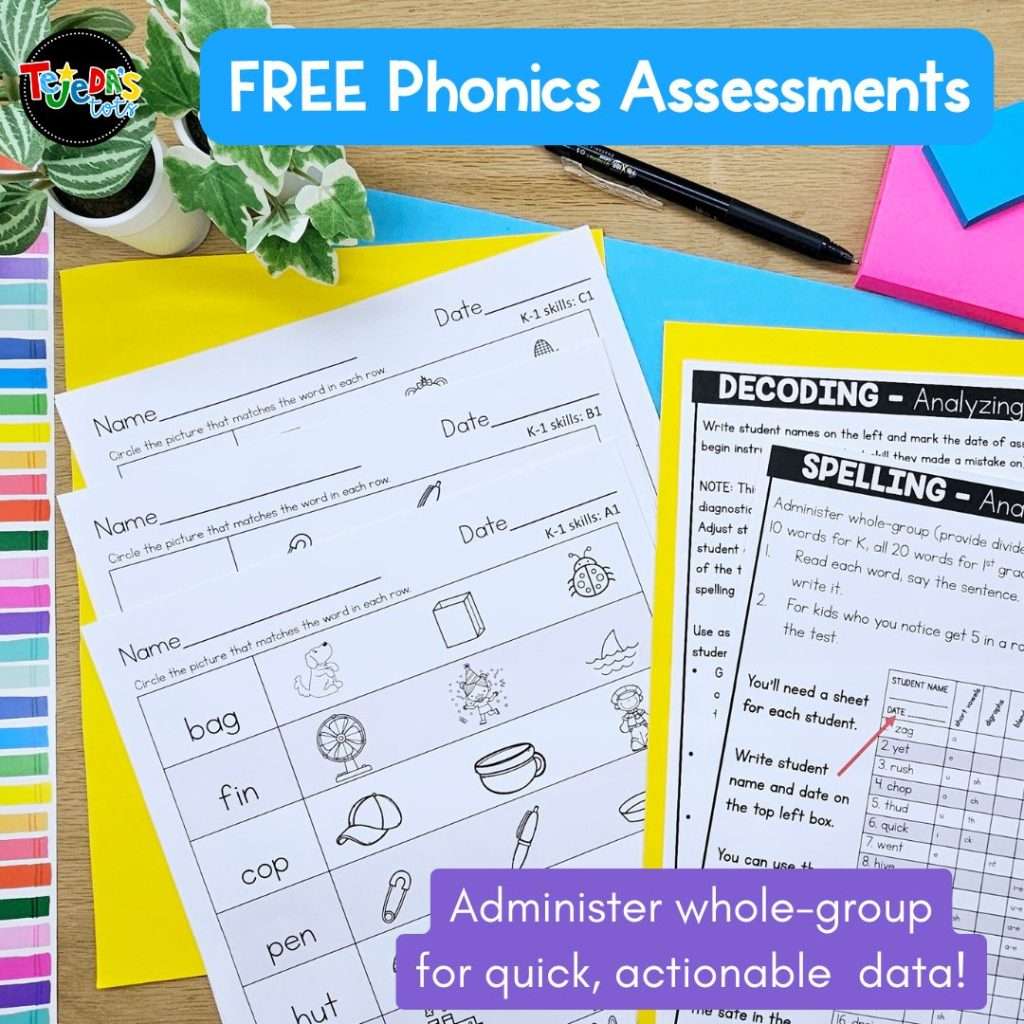
If you’re not sure, don’t worry- I’ve got you covered with a FREE phonics assessment that includes BOTH decoding AND spelling! 🎉
The truth is the kids you grouped in August or September are not the same kids in front of you now. Some have made huge leaps. Others are still working on letter sounds. And that’s OK!
Kids progress at different rates, which means your groups should be flexible and change along with them.
But let’s be real-you don’t have hours to sit down with every student, listen to them read a passage, and take detailed notes. What you need is a quick phonics assessment for small groups to get a snapshot of who needs what right now.
👉Ready to reset your small groups? Let’s dive in!
Fast and Simple Decoding Assessment for Small Groups
Most of your students in K-2 likely need help with decoding skills, so I created a quick, informal decoding assessment that you can give to your entire class TODAY. Yes, today! This assessment will give you a starting point for grouping your students into flexible groups.
And the best part- you can give this assessment to the whole class at once to save you time!
Now, I know what you’re thinking. “How in the world can I assess decoding with a whole group, Brenda?”
Most quick assessments are spelling-based (ENcoding), but here’s the thing: Spelling is typically harder than reading. Think about how many adults can read tricky words like “definitely” but still need autocorrect to spell them right! Similarly, a child might read “step” perfectly but struggle to spell it. That doesn’t mean they can’t decode—it just means their spelling skills are still catching up.
Both decoding and spelling are important, but if you’re short on time, this quick decoding assessment will give you a starting point for forming groups based on which phonics skills your students are applying while reading—not writing—so you don’t miss any gaps.
And if you follow it up with a spelling assessment, you’ll get even more insight into your students’ abilities (and the great news is, I’m providing you with assessments for BOTH).
How the Decoding Assessment Works
This decoding assessment is quick, simple, and gives you actionable data fast. Students read a word on the left and circle the picture that matches it. It’s all about seeing if they can decode the word correctly using the phonics patterns they’ve been taught.
No, it’s not just a phonics worksheet! I took careful extra measures to make it as accurate as possible:
- I chose words and pictures of common objects (nothing obscure that will leave kids scratching their heads). But if a student isn’t sure what a word means, encourage them to ask. You can point to the pictures and say their names if needed.
- The skills increase in difficulty so you can notice where students begin to get stuck.
And here’s what really makes the difference:
- I carefully chose pictures where only the targeted sound changes.
For example, if you’re assessing short vowels, the words might be hat, hit, hot. This way, you can clearly see whether students are truly decoding those tricky vowel sounds—without relying on familiar consonants.
“What about peeking?”
I get it- peeking happens. It’s tempting! That’s why I made several versions of the test. If you distribute them strategically, children won’t be able to . . . ahem. . . “borrow” their neighbor’s answers. Just look at the letter at the top right corner while handing them out and make sure students seated next to each other have different versions.
💡 Quick Tip: Use privacy folders or have students use their notebooks as shields as an extra step to help everyone stay focused on their own work.
How the Encoding (Spelling) Assessment Works
In the spelling version, you read a word, sentence, and the word again. Students repeat the word and write it on their paper.
- There are 20 words total, increasing in difficulty, to cover K-2 phonics skills.
- You do not have to assess all. In kindergarten, you can use the first 10 words. In 1st – 2nd grade, use all 20 words.
- I show you step-by-step how to score and analyze the assessment, so you know where to start instruction for each student. The class spreadsheet will make it easy for you to group similar-skilled students as well.

This Is an Informal Assessment (But That’s Not a Bad Thing!)
Let’s be clear: This is an informal assessment—a quick way to get a snapshot of where your students are with decoding. It’s not meant to replace a more detailed, 1:1 diagnostic assessment, but it’s a fantastic starting point for forming your small groups and planning targeted instruction.
Once your groups are up and running, it’s time to start progress-monitoring. That’s where my Decodable Running Records come in. These 1:1 assessments focus on specific phonics skills and give you valuable insights into your students’ reading progress and behaviors. You’ll see right away whether students are mastering the skills you’ve taught—or if they need more targeted practice.
💡 Think of it like this:
- The quick class-wide assessment helps you get your groups started.
- The Decodable Running Records give you a deeper dive into each student’s progress once you’re ready for more comprehensive 1:1 assessments.
👉 When you’re ready to dig deeper, check out my post on Decodable Running Records and grab a set to track your students’ growth!
Next Steps: Group, Schedule, Plan!
Once you’ve administered the phonics assessment, you’re ready to sort your students into groups based on their needs.
👉 Tip: Don’t overthink your groups! They aren’t set in stone- you can always move students around based on how they perform in their groups.
Tweak your schedule to make sure you’re meeting with everyone as necessary. Read this post for tips on grouping and scheduling and grab my free small group planning kit!
And finally, planning your small group reading instruction doesn’t have to be time-consuming! Read this post for 7 key components to include.
For done-for-you small group lessons, check out my Phonics Intervention Pages:

We all know how quickly students change, and sometimes it’s hard to keep up. But with this fast and easy phonics assessment, you’ll know exactly what your students need—without spending hours testing one-on-one. Grab the FREE resource right here!
Related Blog Posts
Be sure to read these blog posts if you’re looking for how to set up your reading area, an effective lesson routine with 7 key components, and 5 phonics activities that make a BIG impact.
Leave a Reply