


Planning for small group instruction in your K-1 classroom can feel like a daunting task, but with a little thoughtful preparation and some practical tips, small-group reading can become the highlight of your teaching day!
Whether you’re looking to create groups, fine-tune your schedule, or streamline your lesson-planning, I’ve got some tried and true strategies that can help!
Here are the 3 steps I take when planning for small groups:

1. Grouping students
First, start with a baseline assessment. Your district may have an assessment to give you a starting point for each student. It’s important to get information such as:
- Phonemic awareness
- Letter/sound awareness
- Word decoding skills
- Spelling skills
- Comprehension
In first grade and beyond, you can also assess reading with my Decodable Running Records, to give you an overview of reading behaviors and specific phonics skills. (You can also use these in kindergarten after students have some knowledge reading CVC words). These are best for progress-monitoring, once you have provided instruction on a particular phonics skill, or if you already have a general idea of which phonics level to start with.
Once you’ve assessed your students, it’s time to form your groups. Here are some things to keep in mind:
- Group similar levels together- it’s much easier to teach students with common gaps and abilities
- Try to keep your group size small (the more support needed, the smaller the group should be)
- Take behaviors and personalities into consideration
*TIP- Be flexible with grouping. Be ready to adapt your groupings as you gain new information about your students or they progress/ need more support.
2. Making a Schedule
When you have students grouped, it’s time to make your schedule. Think about which groups need the most support. You’ll want to meet with these more often. If you have an assistant, have them work with your more advanced students, since you have the expertise to best support those that need additional help.
Here are some questions to consider:
- How much time do you have for each group? (My groups last about 20 minutes, but yours may depend on how much time you have in your block)
- How often will you meet with each group?
- Who gets pulled out for extra services? When?
Once you know how many groups you can see daily, here’s how you can fill in your schedule.
My groups are labeled 1-6, in order of most support to least support needed.
- Plug in the group you need to meet with daily.
- Then, add the group that next needs most support.
- Add your remaining groups.
TIP: Notice that groups 2 and 3 are reversed on a day. Sometimes I don’t get to all 3 groups, so I order them this way to make sure I don’t always skip seeing group 3.

I like this scheduling form because I can add the main teaching focus right on it to view my plans at-a-glance, and having the names of students in each group lets me quickly see who to call for each session.

**TIP- Not every session has to be the same length. If you’re crunched for time or want to meet with more groups, plan a 5-minute mini-session where you focus on practicing one skill. You can use a game like Write, Read, and Erase, practice high-frequency words, or have kids reread decodable texts or sight word fluency cards.
Click on the image to view Write, Find, and Read on my Instagram page.
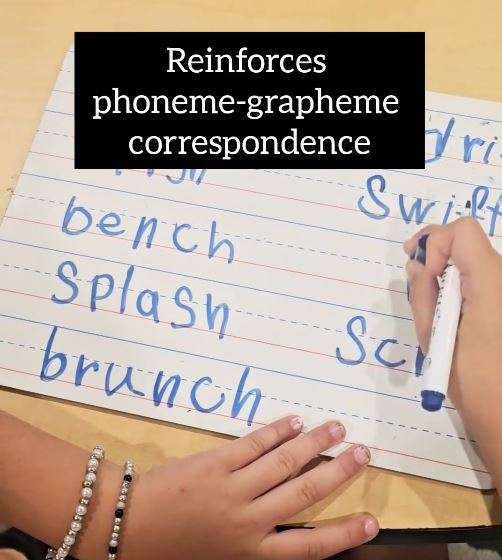
TIP* When doing activities like this, it can be time-consuming to come up with word lists, especially for reviewing skills. My Word and Sentence cards are super helpful because I always have words for each skill at my fingertips.

3. Lesson- Planning for Small Groups
Having a clear objective for each session helps you stay focused! Read this post for what I include in my very first small-group lesson and read this post for the components to include in subsequent lessons!
The Lesson Plan Template
Templates make planning for small groups so much easier! Having a routine to follow helps save you time when planning, and lets students know what to expect as well.
Just plug in the skills and text you’ll be using into your template, then use it as a guide during your lesson.
Here’s a sample of my lesson-planning template. It’s included in all of my phonics intervention packs and is simple to use for planning AND taking notes during your lesson.

You can see that I start by reviewing skills and this includes a 3-part review:
- Sound drill
- Reading/ writing words
- High-frequency sight word review
I also do a quick phonemic awareness activity and keep track of how many sounds each student can blend/segment.
After our review, I teach the new skill, and we do several activities with it:
- Decode (read) words
- Encode (write) words
- Read words in phrases, then sentences or a short passage
- Comprehension check of the text
- Write (Students apply phonics skill in writing a sentence that I dictate)
Sometimes we learn a new high-frequency word and map it as well. You can cover these components with any resources you have, but I like my Phonics Intervention pages because they cover all of them in a sequential way and saves me time when planning. **Get 4 FREE lessons to try below!**

Finally, my biggest tip is to have everything you’ll need at your fingertips because we all know what happens when kids have 2 seconds of free time! #cuethedistractions🤦♀️ Read this post or watch this video for help setting up your small-group reading area.
I hope these tips were helpful to you. In my next post, I’ll show you my system for keeping anecdotal records to help me keep track of student progress! Let me know if you have any questions you’d like me to include.
If you’d like to try my Phonics Intervention Pages, you can get 4 free lessons by signing up below!
Resources in this post to add to your small-group toolbox:


Leave a Reply