

Writing sentences can be hard for our emergent writers. They have to remember a string of words, have a small bank of sight words to work with, and they need to stretch out words they don’t know how to spell. It’s A LOT.
To add to the trouble, many students are hesitant to stretch out words on their own. They might lack confidence, have limited letter-sound knowledge, or over-rely on teacher help.
The truth is students who aren’t independently stretching out words are going to have a tough time writing sentences! Imagine having to cook an entire Thanksgiving feast when even boiling an egg seems like a risky move.
You’ve got to build confidence first!
A list-writing unit can be the perfect transition to get your beginning writers from labeling to writing sentences!

Why List Writing Works!
- Writing lists is less intimidating for beginning writers. Unlike sentences, . . .
- Most lists require only one word to be remembered at a time.
- No pressure of constructing a cohesive string of words
- More practice stretching out words, the skill they need!
2. And don’t forget, list writing activities incorporate important life skills:
- classification
- sequencing
- organization
3. Finally, list writing can be:
- fun
- meaningful
- the perfect bridge from labeling to sentences
Do you see what I did there? 👀😄
Make List-Writing Engaging and Meaningful
Now that you see all the bonus benefits of list writing (in addition to spelling practice), let’s talk about ways to make it something kids look forward to, and not just a dreaded task. By incorporating fun topics and activities, list-making becomes an enjoyable and meaningful task for students.
Key Concepts
I believe in showing kids a purpose for what we teach them, and lists have so many uses! In addition to providing opportunities for kids to practice stretching out words, teach students how lists are helpful in everyday life and real-world situations. Here are 4 important concepts I include in my List-Writing Unit:
Lesson 1: Why do we use lists?
Use real-life examples of when people use lists and how they’re helpful. I like to tell a story of how I went to the store to buy flour, sugar, and butter to make a pie, but at the store, I couldn’t remember what I needed. A list would’ve been super handy!
Brainstorm times when a list would come in handy with your students, where they have seen lists before, and how they help in each situation!

After discussing lists, I like to have a scavenger hunt where my students check off items on a list as they find them (or do them, if they’re tasks).
Lesson 2: How to make a list
Now that students understand what lists are and how they can be helpful, it’s time to teach students how to MAKE lists. This is the perfect time to reteach how to stretch out words to record all the sounds they hear.
Also read: Invented Spelling Dos and Don’ts
You’ll likely have kids that struggle with coming up with a list topic. You can brainstorm topics together, but to get the ball rolling, you can provide the topic for the first few lists. Here’s one of the activities I use in my list-writing unit.

You can differentiate by providing students with items to include in their lists. In this activity, they pick 4 of the 5 options. This helps bypass the time it takes to think of list items and gets right to the practice of stretching out words!
*TIP* You can also ask kids to choose 3 and think of their own for the 4th, if you want them to come up with a list item.
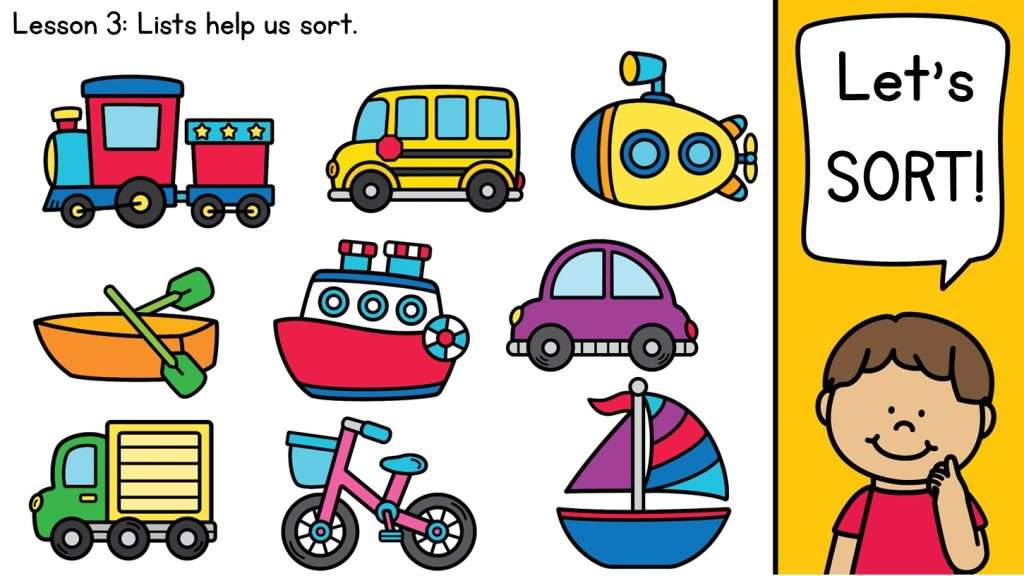
Lesson 3: Sorting information
One of the greatest benefits of lists is that they help us organize information. I know when I’m planning a party, I need a list of guests, a list for foods, supplies needed, and most importantly, my to-do list!
So teaching students how lists can help us organize and sort information is another important lesson.
Lesson 4: Ordered lists
What if I asked you to:
- Buckle up.
- Get into your car.
- Open the car door.
- Sit down.
Whaaaat?! 😵
Some lists are no help at all if they’re not in order! Teach students that sequence is important in some lists because sometimes you need to follow steps in order. For this lesson, it’s fun to give kids directions out of order to see their reaction (and drive the point home)!
Make it Fun!
When making lists, it’s great to make it fun for your students. You can give students fun stationery for list-making. Then, let them use pens, markers, or other fun writing tools. And, most importantly, select FUN topics! (Because who wants to write a list of school supplies – am I right?)
Here are some FUN list topic ideas:
- Superpowers they’d like to have
- Silly recipe ingredients
- Foods they never want to eat again!
- Top 5 candies/foods/shows/animals
- Hobbies
- Book-related
The “list” is endless, so encourage students to unleash their creativity and imagination!

Make it Meaningful!
Make it extra meaningful by having your students use lists to plan an activity you will actually do!
- For example, if you’re going on a class trip to the farm, they can make a list of animals they’d like to see.
- If you’re planning a class party, have them make a list of supplies.
By connecting list-making to tangible outcomes, students see the practical application of their writing skills.
Another way to make list-writing meaningful is to connect list-writing to the books you read aloud. Consider writing a list of characters, the list of foods the caterpillar ate in The Very Hungry Caterpillar, names they would give the pet in The Stray Dog.

Extend the work into Sentences
You can also use lists as a brainstorming tool before writing a sentence or paragraph. Have students choose one or more items on their list to use in a sentence or paragraph about the topic. This lends itself well to my next writing unit, Sentence Writing. Read this post for tips on teaching students how to write a sentence.
Also read: 9 Spelling Strategies to Teach Beginning Writers
List Writing in Kindergarten and First Grade
If you want all of the lessons described in this post, plus TONS of list-writing activities to help your students become more confident with spelling while learning some essential skills, you can grab my List-Writing unit.

Hopefully you see the value in using list-writing as a tool to get your students more independent with spelling. With this new spelling confidence, it will be much easier to get them to write sentences!
What fun list topic ideas have sparked your students’ imagination? Share your thoughts below and keep the creative conversation going!
Related blog posts for helping beginning writers:


Leave a Reply